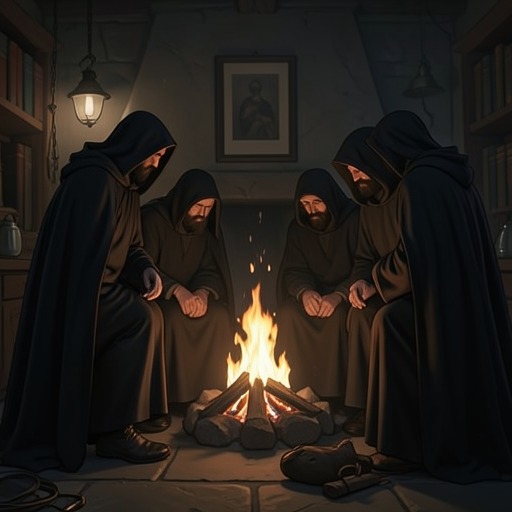
The Secret Letter's Delivery and Safekeeping Protocol
De brief voor de KoningThe secret letter’s delivery and safekeeping protocol makes Tiuri responsible not merely for carrying a sealed object but for preserving a message whose contents he is initially forbidden to know. Its rules specify a recipient, a route to the first contact, a test of identity, strict secrecy, and an emergency procedure for transferring the message without surrendering the letter. As danger closes in, Tiuri must move from guarding the physical document to safeguarding its meaning—and his success becomes inseparable from the choice that first interrupted his vigil as a candidate for knighthood.
Authority, recipient, and identification
The first instructions come from a stranger who asks Tiuri to take a letter to the Black Knight with the White Shield at the Inn at Yikarvara. The route is described precisely: pass behind King Dagonaut’s hunting lodge, follow a narrow road northwest to a clearing, and take the left of two paths. Tiuri is to protect the letter as if it were his life and give it to no one else. The stranger emphasizes that possession alone is not enough: Tiuri must establish the recipient’s identity through a prescribed exchange before handing over the document. The sequence functions as a password, distinguishing the intended recipient from anyone who might merely claim the title.
The instructions also establish a limit on Tiuri’s authority. He is not to decide who deserves the letter or disclose its contents to satisfy curiosity; his task is to keep it intact and deliver it to the designated person. When the wounded knight later explains that the letter is for King Unauwen and that he can no longer carry it himself, the mission changes in scale but not in its central restriction. Tiuri receives the knight’s ring as proof that Menaures, the hermit at the source of the Blue River, should help him cross the mountains. The ring authenticates the courier’s connection to the sender, while the letter remains reserved for the king.
Custody and concealment
The physical safeguards are simple but deliberately personal. The first letter is small and flat, and Tiuri feels its seals before hiding it beneath his shirt against his chest. The knight’s later letter is likewise entrusted directly to him, with a warning to guard it carefully. Tiuri is told to keep the mission secret, tell no one about it, and give the letter only to King Unauwen. Secrecy is therefore not incidental caution: it is part of the delivery rule, protecting both the message and the identity of its intended recipient.
The protocol is tested when Tiuri is questioned about the White-Shield Knight. He gives only the limited description of a knight with a white shield and withholds the fact that the knight has been murdered by the Red Riders. He also conceals the nature of his own commission, explaining that he will tell King Unauwen everything when he can do so safely. This is not silence without judgment: Tiuri distinguishes between information he can safely disclose and the central facts entrusted to him. The instructions make him responsible for resisting pressure to reveal the mission, even when truthful disclosure might seem like the easier course.
The emergency procedure
The letter’s protection has a carefully defined exception. If Tiuri is in danger of having to surrender it, he must read it so that he can convey the message orally; only then is he to destroy the document. The rule does not permit opening the letter merely to satisfy curiosity or to make the journey easier. The contents remain secret until an immediate threat makes the physical letter unsafe, and destruction is authorized only as the last step in preserving the message from an enemy.
When Tiuri eventually judges that this moment has arrived, only one of the letter’s three seals remains unbroken. He opens it, but the safeguard presents a new obstacle: the writing is in a cipher or a language he cannot understand. Only the word Unauwen is familiar. With voices and footsteps nearby, he must try to memorize the text without knowing its meaning, silently repeating its words and sentences. The protocol’s emergency plan thus demands more than opening and destroying a paper. It requires Tiuri to carry an intelligible message in his memory even when the written form gives him no immediate understanding of it.
Trials, compromise, and fulfillment
The mission begins as a violation of Tiuri’s vigil: on the night when he is expected to remain in the chapel, fast, pray, and prepare for knighthood, he answers a request for help and accepts the letter. The narrative presents this choice as a conflict between formal observance and a more urgent duty. Later, the king explains that Tiuri would have received the knighthood had he refused the request; by accepting it, completing the mission, and keeping his promise to Edwinem, he has demonstrated the qualities the ceremony is meant to recognize. The protocol therefore tests not simply his obedience to instructions, but the judgment that makes him take responsibility for another person’s unfinished task.
The letter’s security does not remain intact. At the Rainbow River toll crossing, Tiuri hears that a suspicious stranger asked after a dark-haired, light-eyed youth and reacted sharply when told of a messenger from Dangria. Tiuri concludes that the stranger was Slupor, that the Dangria clerk was killed by an arrow meant for him, and that Slupor took the letter. These details expose the vulnerability of the physical document even as they clarify why its carrier must be cautious. The document may be stolen; the protocol’s emergency provision exists to prevent the message from being lost with it.
Tiuri’s success finally rests on carrying the contents onward rather than relying on the sealed letter alone. He has memorized and burned the document, and he completes the mission to King Unauwen while fulfilling the promise made to Edwinem. The king of Dagonaut later names that completed service as evidence that Tiuri has already proved himself a knight, even before the formal stroke of the sword. In the story, safekeeping culminates not in an untouched seal but in a transformation of custody: Tiuri becomes the message’s living bearer, responsible for preserving and delivering what the paper could no longer safely contain.